Connecting the littoral zone

While I have positioned myself within the littoral zones of the NW coast of Scotland over the past 3 years, to undertake this project, I am increasingly conscious of the need to stand up and to take a look outside of the zone. Projecting my notes helps me keep in mind the vast network of global environmental that each piece of litter connects us too.  The enormity of this bigger picture  makes me keen to make links with other artists focusing on environmental issues .

carbon change projection climate chang projection  oil projection eaten projection

Reassuringly there is a growing number of artists focusing on ‘Nature and Culture’ and  in Scotland many of which can be found through through Eco-Arts Scotland word press site. Many of these artist’s like me embrace working in a cross disciplinary way. Kate Foster is one such artist who is presently working with  a biogeochemist  Susan Waldron and environmental writer Dr David Borthwick on  a project entitled Flux Chamber. All three collaborators will be sharing their knowledge and findings next weekend at the Enivronmental Arts Festival (details below) They will demonstrating how the Flux Chamber measures carbon locked in water by taking festival participants  on a guided walk and exploration of a watercourse around Morton Castle. Together they will be instigating discussions, mapping and an exploration of our carbon landscape.

OLYMPUS DIGITAL CAMERA  Flux Chamber

Artists seem naturally to cross disciplinary lines but it is refreshing when scientists and thinkers do this too. I recently posted a link to a great website called Worldly which highlighted an article by Audra Mitchell a refreshing thinker into global environmental ethics, she boldly states that she is not bound by any medium, and she puts forward that multiple registers of meaning and visual images can help to crystalise the enormities of environmental phenomena. I totally agree imagery can make ideas about difficult subjects more thinkable or imaginable.

casting votes for beaches #IVoted copy  Plastic Rock  my marine object 1

As I explore ways to develop my imagery to tell the complex stories of the litter objects that I pick up, I am encouraged to discover and read about the  work of other artists who are creating successful and arresting visual work that is tackling urgent environmental issues.  Heather Davis and Etienne Turpin have recently edited a wonderful book  ‘Art in the Anthropocene’ published by Humanities Press. It is a publication which creatively and critically looks into the ‘politics of nature and culture’ and is full of the inspiring writings of artists and images of their work addressing a vast array of issues associated with how we are affecting our environment, each other, disputed territories, war, pollution, excessive consumption, migration, the legacy of past generations. Global issues touching us all.

  Art in the anthropocene Book cover aerosolar 2 Museo Aero Solar  Thomas Saraceno

Aerosolar is one of the most outstanding projects of collective visual action I have learned about and now wish to witness, by a collective of artists based in Italy lead by Thomas Saraceno. Museo Aero Solar is a flying museum, a solar sculpture made up of reused plastic bags, with new sections being added each tie it travels the world, changing techniques and shapes and growing in size every time.
So far it has been shown in Italy, Mecico, Canada, United Emirates and France. It is an inventive liberating sculpture which offers a different conception of space and energy by utilizing our waste and free solar (thermodynamic) energy. The Museo Aero Solar will touch down again next Wednesday August 26, 2015 at 21er Haus in Vienna. In the sculpture garden. Free with a valid exhibition ticket.  I certainly wish I could be there!

WORK_disputed01_t Disputed  Senkaku Islands   2014  Map Office

As I am preoccupied with the litter pollution we find on many remote Scottish islands, I was drawn to the work of Map Office and artists Laurent Gutierrez & Valerie Portefaix who are based in Singapore, they often play with island metaphors in their staged hyper realistic photographs and installations. The simplicity and strength of their work is clear in a piece entitled ‘Disputed’ 2014 which borrows (& therefore highlights) elements of ongoing geopolitical disputes around the world about sovereignty, resources . It is a dart game designed to conquer those disputed territories according to the countries that claim them.

Below are a few links to the references made here focusing on nature and culture:
Environmental Arts Festival   http://environmentalartfestivalscotland.com/whats-happening-this-year/ is a free festival which uses art installations to inspire discussion about our environment and our role in protecting it. This year’s chosen space – Morton Castle in Upper Nithsdale, Dumfries and Galloway – is a dramatic festival backdrop that will provoke thought and trigger sensory experiences.
EAFS 2015 takes place over the weekend of 29th/30th August.

Eco art scotland http://ecoartscotland.net/  is a platform for research and practice. A resource focused on art and ecology for artists, curators, critics, commissioners as well as scientists and policy makers.

Art in the Anthropocene http://openhumanitiespress.org/art-in-the-anthropocene.html

Creative Carbon Scotland  http://www.creativecarbonscotland.com

Map Office  http://map-office.com/exhibitions/

Museo Aero Solar  Thomas Saraceno   https://museoaerosolar.wordpress.com/


Still Life

After focusing on taking precise photographs  of 40 different objects individually, for the Guide to Beach Litter,  I decided  to take a few sessions  selecting out objects to combine together  to create a series of simple ‘still life’ images …..

plastic spoon    

flip flop & plastic rocks

…… positioning objects together quickly suggested narrative ideas

‘flipflop trailing plastic rocks’ and ‘Syringe resting on ‘plastic rock’

syringe & plastic rocks

These simple still life’s put me in mind of Eileen Agar’s surrealist assemblages in particular her     ‘Marine Object’ 1939 (below right), in which she assembled a natural rock, horn and star fish.

imagesInspired I set about making my own ‘Marine Object’  using three different beach litter objects I found on beaches this year – ‘rocks’,  fishing line and a spoon. The significant difference being that they are all plastic and require no specialist conserving .

my marine object 1

Working in the littoral zones I have frequently felt like I was inhabiting a  surreal dream/nightmare landscape not dissimilar to Dali’s ‘Mountain Lake’ or  ‘The Persistence of Memory’. Melted plastic bags could quite easily replace the slumped clock over the branches of the tree  in the Memory landscpae

index dali  dali lake

With such thoughts in mind the simple ‘still life’s’ quickly developed into sets and introducing my architectural models the surrealist ideas of playing with shifting scale,  introducing distortion to create confusion and tension all came  flooding into my notes.  Useful ideas which I intend to use in my animation over the next year.

working in ESW ESW staging business mand & plastic products

plastic frame  through the view finder  ESW notes
Photographs taken in the Edinburgh Sculpture Workshop July 2015


Photo shoot

Over the last few days I have sorted through hundred’s of litter items collected across the littoral zones  of  over 20 beaches  on the west coast and more recently Shetland to select 40 items identified  with Dr Cowie  two weeks ago for possible inclusion in the Guide to Beach Litter.

trays litter items

My aim is to select the ‘best’ samples that are representational of what might be found on the beach.

set up seaweed cropped
So far 20 items have been photographed  each item being  shot multiple times on a selection of settings to ensure I achieve the best image possible. The items will be  digitally ‘cut out’ and positioned on the Guide layout . My aim is that the Guide should echo the  natural history field guides where the species are collaged together on each page.

positioning items processing images

But before the processing can begin there are another 20 items to choose, group together, position, reposition and photograph.

caps

I estimate that the ‘Guide to Beach Litter’ will cost £3,000 to produce. £1,100 has been pledged  which will cover the photographing , processing and layout of the work . I still need to raise  £1,900 to  cover the printing  – ideas of how to raise this would be much appreciated.   Many thanks.

Donations to the project can be made through Paypal  check out how to do this on the Sponsorship page.

Celebrating – World Environment Day

To celebrate World Environment Day #WED2015 today I crossed the Clyde for a meeting with marine biologist Dr Phillip Cowie at the Millport Field Study Centre FSC on Cumbrae to begin to map out the ‘Guide to Beach Litter’.

Fairly beach  ferry toCumbrae
We began by making a long list of 40 commonly seen litter items, trying to cover items made of different materials , coming from a range of different sources, i.e. originating from the land , the sea and whether they are from commercial or beach users. I will circulate this list around groups such as the Marine Conservation Society  Shetland Dunna Chuck Bruck group and other organisations /groups cleaning beaches around the Scottish coast to see if the list is representational . If anyone reading this list feels I should consider including an item I have not listed that they see in significant numbers please get in touch – use the comment box below or e mail  littoralartproject@btinternt.com

Long list
PLASTIC 1. fibres 2. bottles 3. Gunwads/cartridges 4. Ropes 5.Food wrappers 6.Mussel pegs 7. String /cord 8. Caps/lids 9.barrels 10. Wipes 11.cigarette lighters 12. Drinking straws 13. Work gloves 14.fishing nets/pieces 15.fishing line 16. Melted plastic rocks 17.Strapping bands 18.Plastic pieces 19.Bags 20. Pack Yokes 21. Syringes 22. Pellets/nurdles 23.cotton bud sticks 24.tampon applicators 25.sanitary ware strips
POLYSTYRENE /STYRENE 26..Polystyrene pieces 27.Foam
METAL 28.Aerosol cans 29.Drinks cans 30.BBQ disposable 31. Scrap metal 32.Batteries 33.Foil food containers
RUBBER 34.Balloons 35.Tyres WOOD 36.Pallets/crate GLASS 37.Bottles CERAMIC 38.pottery   OTHER 39. Tarmac 40. Concrete

Millport visit 2  Millport Notes

Our conversation on litter items ranged widely interestingly discussing the least hazardous materials first – glass and ceramics – which once they have been rounded with the wave action they pose a relatively small hazard to marine organisms the wider environment and ourselves. From here we launched into the plastic abyss and we noted down the vast array of hazards they pose to all organisms including our selves touching on the research studies now taking place of the effects of plastics if/when eaten by us in seafood.

Strapping black Burwick  DSCF9521 Plastic bag scottish CU Burn beach melted rope
The plastic items will undoubtedly make up the biggest section on the guide, as more and more items like work gloves we call ‘rubber gloves’ are now commonly made out plastic. A reflection of the plastic nature of our world . Clear images of the litter items, like the one below will be used in the Guide with simple descriptions which will include usual dimensions and the material/s

Plastic Rock
This #WED2015 has been a wonderfully positive day thanks to donations given in response to my Crowd Funding appeal last month.

The next step is to raise the remaining money needed. So far £675 has been received and this will cover the photography work and first draft of the text , the remaining pledged money (another £530 ) will cover the consultation process, editing, design and layout work. I am still looking to raise £1,800 to print the Guide, please get in touch with any suggestions.
New and pledged donations can be made through PayPal using the project email address littoralartproject@btinternet.com press ‘pay for goods & services’. If in doubt go to the Sponsorship page.  Don’t forget to leave a message if you would like to receive a reward of a Guide or beach litter key ring. Many thanks.      I will keep you all updated on the progress of this piece of artwork.


Exploring ideas in the Shetland Isles (1)

13.5.15: Arrived Sumburgh Airport

DSCF9488
Plastic toy plane found on Shetland beach last week

I flew to the Shetland Isles to explore ideas in person with Sita Goudie of the Shetland Amenity Trust to  discuss ideas of creatively working together  to  deliver a Shetland Littoral Art Project  in the future. I was met by Jane Outram the Trust’s Environmental Awareness Officer who within the first hour introduced me to Angela Hunt manager of Sumburgh Head and gave me a fascinating tour of this  fantastic heritage centre with working ligthouse, bird reserve and arts venue.
DSCF9427 DSCF9449 DSCF9454 DSCF9443

Sumburgh Head Lighthouse has played many important roles saving mariners lives  and through out the war with its temporary radar station.

DSCF9436 DSCF9464 DSCF9470 DSCF9468

The Lighthouse  seemed a pertinent start to our discussions together as we walked passed a chute in the wall down which waste used to be dropped into the sea and then examined a metre high bone from a sperm whale’s head which had washed up nearby tangled in fishing nets. Some patterns of behavior have changed dropping waste directly from lighthouses is illegal in most countries, but its estimated that we dump 6.4 million tonnes of litter into the sea every year.

15.5.15  I was able to join  77 pupil plus teachers from the Scalloway  Primary School for the last 2015 Da Voar Redd Up (Spring Clean up) event organised by the Shetland Amenity Trust (SAT). The S.A.T  have managed to encourage more and more of the communities around Shetland to join in with collecting litter from beaches, roadsides cliff tops all events are catalogued on the Dunna Chuck Bruck Facebook page

Friday’s task was to clean Burwick beach a mile NW from the school. This is the third year that the school as risen to the task and spirits were high as 5-12year old children walked over the hill and down to the beach.

Burwick beach  MS before 2

The beach I took in was as bad as the beach that started me off on this Littoral Journey in 2012

IMG_4321 DSCF9496 DSCF9521 DSCF9507

For me the mounds of  broken down rope fibres 1/2 m deep that almost created a plastic raised beach at the top of the littoral zone was painful to see.  As I  scooped and pulled at the matted fibres to bag it up. I was thinking that this is where rolls of seaweed should have been lying, thoughts especially coupled with the knowledge that hundreds of thousands of organisms will have ingested such fibres the effects of which are still to be understood.

IMG_4331

Burwick beach  WS before   DSCF9530

In total 254 bags of litter were filled and removed from the beach, while  there was still much left to do a significant difference was made.  Well done to everyone who took place especially the youngest members of the team. Millions of reasons to work together to devise creative ideas to help to change our behavior which presently allows this to happen.

#IVoted

casting votes for beaches 1

Over the last few weeks I have carefully cast my marks within the ‘littoral zones’ of our coastline.Marks  writ large on Luce Bay (Dumfries) with lines of washed up plastic gun wads threaded together

casting votes for beaches 2

Bold marks made with washed up sections of plastic prawn boxes

mixed col X white X Purplr & white X

Blue X red X green X

Small marks on Portobello beach using beach-goers litter, spoons, pens, cotton bud sticks , plastic stirrers plus commercial fishing tags and cord. These marks are addressed to all the party’s regardless of their colour.

Please cast your vote for the marine environment and the arts today @LittoralArt #cleanseas #cleanbeaches    Check out what the Littoral Art Project is doing, send me your comments, press the follow button on this page and consider supporting funding the work of this project.

Above all vote for a cleaner and creative world!

Beach style campaign

My  campaign trip to the Dumfries coastline  to raise last minute support for the ‘Guide to Beach Litter’ developed into an exciting days work on Luce Bay Beach. The bay is vast and the beach extensive and has a great mix of sand, shingle and rocks. Perfect for anyone’s bank holiday.  Thankfully the day was bright and sunny though the brisk very cold winds kept all but the hardy seaside visitors away.

IMG_4383 IMG_4387 IMG_4424 IMG_4386  

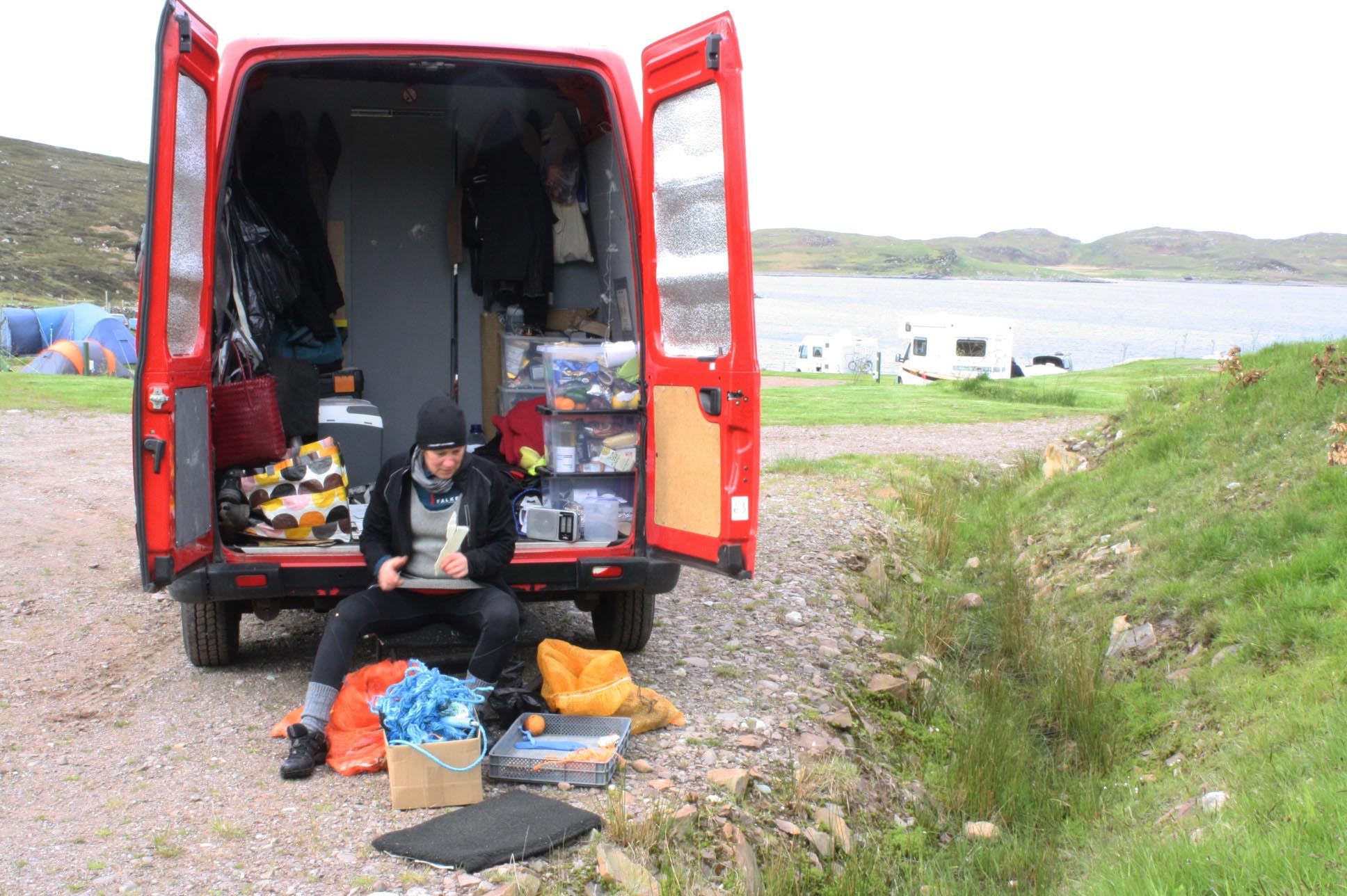
I set the van up as a Sci-Art beach investigation unit alongside the beach, highlighting a selection of my findings so far  and open to all  beach goers. Discussions with intrigued visitors ranged widely from beach litter, to concern about the increasing acid levels in the sea and to fears of over fishing. On the beach I began mocking up a ‘Guide to Beach Litter’ using the litter I collected from along the strandline. The process of laying out the litter made me realise how complex the decisions to decide what to include in the Guide will be, in order to highlight the different : materials ,  hazards, and groups of people responsible for the litter.

DSCF9316 DSCF9383  particles in petridish
The item that drew most attention was in fact the collection of minute  fragments of mixed platic pieces and fibres that are found in the sand and amongst the seaweed.  I explained that these fibres and micro plastic particles are now being ingested by fish and marine organisms. The conversations reminded me of my dismay at being told by marine biologist Dr Philip Cowie  that organisms as small as sandhoppers had been found to ingest micro-plastic fibres.  As I had the ‘lab’ all set up I placed a (found) dead sand- hopper under the microscope and placed fibres beneath it to explore the visual connection. An idea I intend to pursue.

DSCF9408   DSCF9400

I was asked what I was filming as I shook a glass flaskcontain in front of the camera.  I explained that I was experimenting with the idea of how it would feel to be in the sea surrounded by plastic particles rather than plankton.

DSCF9346 DSCF9359

Flask contents : water , plastic particles and fibres plus architectural model  figure.

 ‘Well you have opened my eyes  with that, I never realised that’s what happens’                                     Alan local man

Yours is a great project and is doing a great job to make us aware of our environment. When you think about it the way we live has to change! ‘ Hugh from Whithorn

To celebrate these  encouraging comments in the Littoral Art Project’s work,  I spent the evening translating their verbal votes of confidence into visual votes on the beach.  As the tide receding I marked out  two X’s  using ‘litter lines’ made of prawn boxes and gun wads stitched together on Isle Martin last May.   One for #cleanseas and the other for #cleanbeaches

IMG_4392

A full compliment of X’s will follow soon with the appeal and sponsorship update. Many thanks to everyone who pledged support, together there has been over £1,000 pledged. I am presently setting up a  [donate] button on the blog and I hope everyone will be happy to donate their pledges via this PayPal system instead of via kickstarter. Thank you!

IMG_4402

Campaign Trail…..heads west

Campaign trip 2draft

The count down to the close of my kickstarter appeal to fund the production of  a ‘Guide to Beach Litter’ is fast approaching  4thMay (11pm BST )

Responding to a backers comment that  ‘ I think your project is important and really interesting. We were down in Dumfries and Galloway recently after very high tides and there was mounds debris on the beach’ I have decided to take the project  van out to investigate and campaign  this weekend May 3-4th on the beaches of  Dumries & Galloway beaches.

This is an area of the coastline I don’t know well so please contact me by leaving a comment below/ or email  me with  specific suggestions beaches to  visit – I do need to be able to park the van close by so I can invite people to join me to  identify beach litter items and to make a large identification chart on the beach and to discuss the dangers they pose to wildlife , us and the wider environment.

I will encourage  visitors to  use Littoral Sci-Art Unit microscope, lenses and to carry out simple experiments and to share their observations cast their vote for Cleaner Seas and make a pledge to help the production of the ‘Guide to Beach Litter’

Please join in this campaign and send in comments photos from your beaches to me at littoralartproject@btinternet.com

Take a look at the Appeal


Appeal Update

A big thank you to the first supporters from across the UK, US and Canada who have generously pledged support to produce the ‘Guide to Beach litter ‘   so far the  Kickstarter Appeal has raised £573 .This is a wonderful achievement  in these difficult  economic times.

The Appeal ends in 8 days time on the 4th of May  . So please pass the link to the Littoral Kickstater appeal  http://kck.st/1Fx9ret  so we can raise the remaining £2,437  needed to produce the  ‘Guides to Beach Litter’

The £573 raised so far will fund photographing all the litter items.

The next £300 will fund going to Millport Field Study Centre  on the Isle of Cumbrae to collaborate with Dr Phillip Cowie Marine Biologist to ascertain the the environmental hazards each litter item poses. An edited version of the risks to wildlife, the food-chain and the wider environment will be included in the Guide.

£600 will will be spent on the  graphic layout and approximately £1,500 will be spent on the printing of the full colour  fold out chart

litter guide

The limited edition of charts are being offered as rewards along with key rings made from beach litter items that have been branded with the locations where they have been found. Take a look at the appeal film and please get in touch with any ideas to promote the appeal.  Like all the  parties I will be taking to the road at the end of the week in the Littoral Arts Project battle-bus to campaign and promote the message for cleaner seas in the littoral zone. Will keep you posted as to the beaches we will be visiting…..

litter sorting  Beach sign copy

Please follow the blog by pressing the ‘follow’ button in the left hand margin of this post and follow the facebook Littoral:sci-art project

Kickstarter Appeal

Littoral – Kickstarter Appeal 2015

I am planning to use the information I have collected over the last 18 months on beach litter, to make a  series of contemporary artworks for a Littoral Art Project multi-media exhibition

I am asking for your support to produce a key part of this exhibition, a laminated colour
Guide to Beach Litter                             

The guide will help facilitate workshops with community groups that I am scheduled to work with as the exhibition is created and tours Scotland over the next 2 years. The locations are as follows; Shetland, Inverclyde, Ullapool, Peterhead and Edinburgh.

Rewards for your donation include copies of the Guide to Beach Litter and key rings made from items of up-cycled beach litter marked with the location they were recovered from.  Please click on the link below for more details and pass on to friends, colleagues and post on appropriate websites/blogs.   Your help is much appreciated.   Thank you