2014 A Year in the littoral zone

Having completed a year’s research monitoring beach litter on the west coast of Scotland, I have selected twelve images that I feel summarise my findings along the west coast ‘littoral zone’ . The beaches I have surveyed are Grid- referenced and are located between Loch Broom (NH 133 939) in the south and Loch Inver (NC 094 973) in the north.

Ullapool E beach gun copy

Toy Gun Plastic   Ullapool
A poignant find that lay washed up along the upper shore of the north east beach of Ullapool. I have found toys on every beach I have surveyed.

Rhue polystyrene copy

Polystyrene   Rhue point
A common sight on each of the beaches I have monitored. Often large blocks, boxes or takeaway cups break into individual particles that float and litter the rock pools when broken against rocks. They are subsequently ingested by birds mistaking them for food.

IM plastic bottles copy

Bottles Plastic   Isle Martin
Found on every beach. Along the Back Beach (Camas a Bhuailidh) on Isle Martin the nearest of the Summer Isles in the mouth of Loch Broom, I recovered over 100 bottles which had contained drinks, cleaning fluids, oils etc. All the bottles towed from Isle Martin on World Environment Day were recycled.

IMartin melted plastic copy

Melted Plastic   Isle Martin
Hard to see rock-like forms which blend into the cobbles of the Ross-shire beaches. These predominantly grey plastic forms are the result of plastic rubbish that has been burnt on ships/trawlers or on the beach.

Dun Canna strandline mix copy

Strandline mix Plastic   Dun Canna
The strandline of this west-facing beach on Loch Kinnaird is one of the worst I have witnessed . Broken fragments of every type of litter is mixed into the seaweed.

Badentarebt prawn box copy
Prawn boxes   Badentarbet
Unsurprisingly, in a significant prawn fishing area, broken corrugated plastic prawn boxes are common place on every beach survey .

Badentarbet rope copy

Rope, cord, line and nets   Badentarbet
The highest percentage of litter that I have recorded has been made up of commercial fishing related materials such as ropes and cord: none of these at present can be recycled in the Highlands.

Altandu measuring cylinder
Fibres Plastic   Altandu
Close between the cobbles, sand grains or within the seaweed are millions of plastic fibres from deteriorating rope, bags, boxes which could be ingested by birds, fish and sand hoppers. I collected 1/2 litre of fibres  from 1m of  seaweed along   (Camas an Fheidh)

Altandu toy soldier copy

Soldier Plastic   Altandu
I found this soldier amongst one of the most severely littered beaches in the area. I intend to enlist him in my Littoral Art Campaign in the coming year

Rief loch gun catridge copy

Gun cartridges   Loch of Reiff
It was explained to me by two local beach watchers & cleaners in the Reiff area that the opaque splayed tubes that are numerous along beaches in this area are the inner sleeves of gun cartridges. In the water they are often perceived as squid by turtles and porpoise and eaten.

reiff loch cabling copy

Plastic tubing   Loch of Rieff
Evidence of large scale commercial dumping like this mass of plastic tubing is evident on the beaches close to commercial fishing areas. The scale of it takes your breath away

lochinver takeaway spoon copy

Food containers & implements   Loch Inver
On a much smaller scale but equally insidious is the common takeaway litter stuffed/trapped between the strandline rocks of harbour walls

I intend during 2015 – 16 to make artworks to hopefully encourage all of us to keep our seas and littoral zones clean. Please keep reading and supporting this project in any way that you can. Happy New Year


Invitation

Invitation 2nd version


As my
Littoral Art Project  and I have now completed a years work  investigating beach litter I am busy editing through the hundreds of images  taken while carrying out the many events along the Ross-shire  coast. My aim is to put together a thought provoking visual presentation of the ‘story so far’ , the  30 minute show  will include highlights such as :

The background to how the Future Fossil Collection was created

Young peoples discovery that a plastic bottle might be around longer than them

The curious appearance of oranges on local beaches

Tales from Ullapool High School’s Beach CSI Team

Her stay as Artist in Residence on Isle Martin & developed her rowing career

Her collection of not fantastic plastic

The achievement of two skiff teams on World Environment Day

Her continued close relationship with Scotland’s’ Waste Transfer Stations

Ullapool Museum  & I hope that supporters of the project will be able to join us on either Monday 27th at 7.30pm or Wednesday the 29th at 11.30am to enjoy the visual presentation of the Littoral Arts/Science Project which led to the creation of the Museum’s recent exhibition Future Fossil Collection. The events are free and refreshments will be served.

My intention is to continue to create artworks & events  on our beaches with the aim of encouraging people to take greater care of our coastal and  marine environments.

With this in mind the Ullapool SYHA and I are planning the second annual beach clean of the Ullapool beach below An Pollan Park  on Saturday the 25th October. Please join uson the beach at 1.30 pm

Recycling sea litter

Tracking  the recycling journeys of litter across the country and beyond has made me realise just what an infinitesimal amount of resources we are wasting by chucking our litter into the sea and into landfill. As most of our natural resources are finite the more we can collect, reclaim and reuse the less resources we have to mine and the e cleaner our  environment will be

[Resources we need ÷ resources we reclaim = resources we need to extract]
An obvious equation but one which often gets skewed towards extraction through lack of commitment, but there are many companies and communities that are out there shouting out loud and clear about how the environment needs us to pay heed to this simple Maths!

A few months ago Ecover, the Green cleaning product brand launched ‘Ocean Bottle washing-up liquid’ the world’s first washing-up liquid bottle made from reclaimed ocean plastic which is now on sale in UK. Ecover worked with a manufacturer Logoplaste to combine plastic trawled from the sea with a plastic made from sugarcane (which it calls Plant-astic) and recycled plastic. In the initial trial, 10% of the plastic in the new bottle will have been retrieved from the sea, they are hoping to increase this proportion significantly in time. The quality of plastic retrieved from the sea is highly variable so it meant it had to be blended with other recycled plastic material to make it robust enough for a household cleaning product.

index index indexindex

What a great way to highlight the sea litter issue to recycle it into an object that is all too often found on our beaches certainly along the majority of  standlines I have surveyed. Plastic bottles are one of the most common domestic items to be washed up.  We retrieved 106 plastic bottles from the beach on Isle Martin, unfortunately many more were left behind through lack of time.  Often the bottles are blown beyond the strandline, in exposed places sometimes hundreds of metres inland, vegetation grows over them and we re only aware of their presences when we walk over them and hear that plastic crackling plastic sound

TED ent bottle   IMG_2312
The Marine Conservation Society, states that plastic debris accounts for almost 60% of all litter found on UK beaches, with much of it ending up in the sea. Fish in the northern Pacific Ocean ingest as much as 24,000 tonnes of plastic each year – the equivalent of 480m two-litre plastic bottles. Around 46,000 pieces of plastic are swirling around every square mile of ocean.Fish in the northern Pacific Ocean ingest as much as 24,000 tonnes of plastic each year – the equivalent of 480m two-litre plastic bottles.
Philip Malmberg, chief executive of Ecover, said: “The scale of the ocean plastic problem is enormous – every year at least a million sea birds and 100,000 sharks, turtles, dolphins and whales die from eating plastic. There is no choice – we simply have to aim to clean up ocean plastic for good.”
Ecover has joined pioneering group of manufacturing companies  who are  using their products to raise environmental awareness to the vast amounts of waste we throw into the seas . In 2010 Electrolux  launched a Vac from the Sea” project in which they partnered up with volunteers (individuals, group and environmental organizations) to collect plastic from the Pacific Ocean, the Indian Ocean, the North Sea, the Mediterranean Sea, and the Baltic Sea. The items they collected were then transformed into five state-of-art vacuum cleaners, each one representing one of the seas or oceans from which the plastics originates.

images seas plastic from sea vacs 1
Image Courtesy: From Left to right—The North Sea Edition, The Indian Ocean Edition, The Mediterranean Sea Edition, The Pacific Ocean Edition, The Baltic Sea Edition, Green Range Ultra One. Electrolux Vac from the Sea
The Electrolux company states on it’s on the corporate website that : “The vacuum cleaners embody the plastic paradox: oceans are full of plastic waste, yet on land there is a shortage of recycled plastic for producing sustainable vacuum cleaners. Electrolux makes Green Range vacuum cleaners from 70% recycled plastic, but wants to reach 100%.”
This seems to me a great corporate response illustrating how the collection and reclaiming of our waste can help to re-balance ourskewed resources equation and at the same time as raising our environmental awareness to sea litter. The vacuum cleaners were auctioned to raise money for further research and ocean cleaning. I hope Electrolux’s research continues and like Ecover they are able to devise increasingly more effective equipment to fit on more trawlers with which they are able to retrieve greater amounts of plastic for cleaning and recycle.


N.B Ecover’s manufacturing partner in recycling the bottle waste  is a company called ‘Closed Loop’. The managing director of this company Chris Dow who last night appeared on radio 4’s Bottom Line explaining the recycling process  of plastic bottles at his high-tech recycling plant in Dagenham, east London where they process 5 million bottles a day!


Appeal

appeal

After the excitement of illuminating the plastic litter issue which is happening on our beaches, for the TEDx University of Edinburgh  audience I am now  head down working out how to make  my 2014 Littoral plans happen.

appeal 2 appeal 1 appeal 5 appeal 6 

appeal 3 appeal 4 appeal raise funds appeal 7

All my thinking and notes lead back to the need to raise funds in order to make to following happen:     

  • create and install an exhibition and installations for Ullapool Museum and town locations
  • carry out a beach litter investigation on a remote beach with volunteers
  • at the end of which I will construct ‘litter rafts’  that will be towed to a point for recycling
  • the process and outcome of which will be documented and    reported

Hence my big sponsorship request which I have set up with Sponsume an  on line crowd funding site, the link below leads you to my  video appeal and details of what you will be funding and the relief prints I will be making and offering as rewards for donations. Please pass the link on to anyone you think might be interested. Any other ideas of how/where t raise funding would be much appreciated.

http://www.sponsume.com/project/littoral-sci-art-project-2014

appeal

Thinking…..

…..in Abundance, in the company of  350 people attending the  TEDx* talks on Friday at  the University Edinburgh.

TED ent bottle

My contribution was to create an installation to spark discussion and catalyse debate about Scotland’s problem of beach litter

Talk attendees were asked to follow the sound of the sea  to find the installation,  along the way passing  statements about the condition of the beaches and litter found. Reaching the installation room they were asked to Enter, Consider  and Respond –  by tweeting a picture and comment. On entering the room the viewer was confronted by a collage of projected images of seemingly massive floating plastic  bottles which emanated from seven overhead projectors positioned throughout the room . Participants were encouraged to walk around, reposition bottles on the projectors  and to ask questions about the issue. Many engaging in discussion with me about the  major part that plastics plays in the problem.

IMG_1628  IMG_1689   IMG_1665   IMG_1666

IMG_1673       IMG_1635      TED entrance      IMG_1712      IMG_1655    

IMG_2974   TED installation 2   TED comment  TED comments & fossils

A display of a few of the ‘future  fossils’ helped to introduce the issue of the longevity of the litter problem and my new crowd funding appeal video gave an on the beach background to the project.  In the centre of the floor a 1 metre square was marked out with plastic drinks bottles I had recently found in a similar area on a beach last month , bottles like the ones we use everyday for 5 minutes which might have  contained  water, juice, coke …. prompting the question why are we using bottles made of a material that lasts up to 1,000+years when the contents are drunk in a few minutes ? Prompting comments like:

 It’s not even good for you to drink out of ta plastic bottle!!  

Where does what you drop end up? Here               One day the ocean will throw it all back at us

We’re paying today the price  for a  mind set from a time when environmentalism still didn’t exist in our vocabularies

Make rubbish valuable e.g. non throwaway bottles.

There needs to be an incentive to recycle. For example in Scandinavia you’re charged 20c per bottle if you return it , you’re given money back. In my time living in Finland I didn’t once see bottles lying around.

Please comment on the installation and the event

* TEDx is designed to give communities, organizations and individuals the opportunity to stimulate dialogue through TED-like experiences at the local level. TED’s mission is to freely promote “ideas worth spreading”. TED Technology, Education,  Design. Talks are offered for free viewing on line in 2012 TED Talks had been watched one billion times worldwide

Is the ocean broken?

The  Newcastle Herald’s report on Ivan Macfayden’s statement ‘The Ocean is Broken’ which I posted a few days ago is  thank fully drawing attention to the floating pollution and over fishing issues, which  can only be for the good, as these issues  often seem to be unseen or overlooked. If such random dumping of litter was going on  on land to this extent  their would  be a much  greater focus on monitoring the situation and tracking down the offenders.  One counter view  to MacFayden’s is by Carlos Duarte who puts forward  the question ‘Is the Ocean Broken?’ and argues that we can all help to protect it through our life style choices, political actions  and in our every day choices shopping. See what you think.

Director, Oceans Institute at University of Western Australia

An article entitled “The Ocean is Broken” is making waves on social media. In this emotional article in The Newcastle Herald, a yachty, Ivan Macfadyen, reports the lack of fish and marine life and loads of garbage at sea in a sailing trip across the Pacific to conclude that the Ocean is Broken.

I understand Ian’s feelings, as I too have sailed many – tens of thousands – ocean miles as a researcher on board researcher vessels across all oceans and as a sailor on my sailboat enjoying the slow and silent pace of life propelled by wind and waves.

Ian Macfadyen touches upon two issues I have discussed here, overfishing and plastic pollution. These are real problems, as more than three-quarters of the ocean’s fish stocks have been depleted, sometimes beyond recovery, and, particularly, the global tuna fishery can be better portrayed as war on tuna than as a fishery. Fortunately, Australia’s fisheries are generally well managed and most of our fish stocks are still healthy and strong.

The ocean also contains large amounts of plastic debris, floating across the world’s ocean, harming marine life.

Yes, Macfadyen is right, there are plenty of problems in the ocean, but it is not yet broken. I am increasingly upset about reports that portray the ocean as broken and helpless. We scientists are to blame, to some extent, as we love bombarding people with trouble and bad news, composing a narrative that is overly apocalyptic, what I refer to as the plagues of the ocean. Depicting the ocean as broken makes the problem seem boundless and eventually deters society from engaging, giving up to an ocean portrayed as already broken.

The conventional narrative extends from plastic pollution and overfishing into a litany of plagues including the proliferation of impacts associated with climate change, hypoxia, eutrophication, ocean acidification, marine pests, such as spreading jellyfish blooms, and loss of valuable habitat. Many of these are happening, but their severity and immediacy are sometimes exaggerated through a feedback loop involving, among other factors, spinning of research headlines to compete for media attention. This is why I enjoy writing for The Conversation, providing a direct contact between a readership of educated citizens and scientists, devoid of mediators and media hype.

Let’s focus on Macfadyen’s evidence for a broken ocean: two snapshots of the Pacific, 10 years apart, suggesting a depletion of marine life and huge plastic pollution.

The ocean is a dynamic ecosystem, showing broad fluctuations over time in almost all properties, from physical and chemical properties to the largest fauna. These fluctuations often deceive the casual observer and high-quality data involving systematic long-term observations are necessary to detect real changes from the noise in these fluctuations.

For instance, my co-workers and I conducted an analyses of global changes in jellyfish to find that there is no basis to support the claim that they are increasing globally, one of the plagues of an allegedly broken ocean. Our results, reported this year, showed that jellyfish experience broad fluctuations of approximately 20 year cycles that mislead scientists and the public into the perception that the most recent rising phase of these cycle (roughly between late 1990s and 2008) was an unprecedented event signalling, again, the oceans being broken.

Put simply, our analysis showed that such fluctuations happened in the past, but very few scientists were watching and they lacked channels, such as the internet, to share their results.

Likewise, we also now know that many changes that are portrayed as symptoms of a broken ocean, such as coral bleaching, outbreaks of populations such as that of the of crown of thorns starfish or toxic algae, and others, may largely represent symptoms of global oscillations, which we do not yet fully understand and where human drivers may play little or no role. Separating natural process from human impacts entwined in such fluctuations is a daunting task, so we should not be too quick to jump to conclusion and blame humans for all changes we perceive in the ocean.

Australia has given itself a model system to observe its oceans, called the Integrated Marine Observation System, including a broad array of tools to observe ocean properties from physical to biological with an emphasis in detecting change. IMOS has set the benchmark for marine observation systems around the world by the scale, scope and thoroughness of its components, and the fact that all data are freely available to all.

Australians should feel proud of the development of IMOS, but how can you feel proud about something you’ve never heard about? We, scientists, need to step up our actions to communicate to the public what we do, and the outcomes of the small share of taxes that is allocated toward the stewardship of our oceans.

In fact, the Achilles heel of IMOS is likely its sustainability on a landscape of increasing austerity of public expenditure, threatening to do away with programs such as IMOS, which struggle year after year to survive and continue to deliver value to Australians and the world. But we cannot monitor the oceans just with buoys, gliders and satellites, we need to be able to go to sea and take samples to verify what our instruments indicate.

Australia is grossly under-resourced for research at sea, with a capacity for seagoing research across our 40,000 kilometres of coastline, comparable to that of Belgium with only 70km. But a major milestone in addressing this chronic problem will soon come to fruition with the launching of the R/V Investigator, arguably the world’s most modern research vessel, an oceanic class 94 m vessel being built in Singapore and soon to be sailing our oceans in voyages of discovery and stewardship under CSIRO management.

Availability of observations and research capacities at sea allow us to build and verify models to grasp ocean dynamics. Soon after the tsunami of March 2011 that triggered the Fukushima accident, NOAA published models that predicted how the huge patch of debris washed to the ocean by the power of the retreating waves would take three years to travel across the ocean to strand, sometime in March 2014, along the beaches of California, Oregon and Washington in the USA.

Had Macfadyen checked NOAA’s web page, he would have been prepared to meet the garbage patch he encountered with such a devastating emotional impact. I gave a public lecture on this topic at UWA on October 15th, but I could not download the latest model predictions from NOAA, as this essential system had been down due to the budgetary crisis in the USA.

The tsunami was not a human-driven impact, so we should moderate the feeling of guilt about so much debris, along with many human lives, lost at sea. It does, however, provide a brutal exposure to the reality of our lives, surrounded by a fever to consume and dispose of too many objects, many of them manufactured with materials made of or containing harmful chemicals, that we get to use just for a few minutes and throw away, as with most plastics.

What kind of fishing line did Macfadyen use in his first voyage? What happened to this fishing line when he was done fishing? What harmful chemicals went into the antifouling paint for his boat’s haul? These are the kind of questions we must be asking ourselves, and bring down our footprint in the environment before a tsunami washes all our useless artifacts into the ocean.

Likewise, do we ask ourselves how and where was the fish we consumed with our last meal captured?. Did it come from a sustainable fishery or a sustainable aquaculture farm?, Did we bother to ask if it was a certified product? Do we demand that this information be displayed to guide our choices as consumers?

Should we eat tuna, which at trophic level 5 in the food web sits at the same level as a monster eating wolf-eaters, or should we settle for sardines, oysters and seaweed for tonight’s meal? Was that chicken we ate yesterday for dinner fed fish flour? Do we drive a 4WD car contributing to releasing CO2 that will acidify our oceans further, or do we cycle, drive a hybrid or electric vehicle or catch a bus powered by biofuels?

Do we vote to have our marine parks and carbon tax removed because we, Australians, with one of the strongest economies and highest per capita footprints in the world, cannot afford them?

These questions are not easy ones to ask ourselves, but are needed to force us to confront our contradictions. We enjoy eating seafood, which is an essential component of a healthy diet. We know fisheries are depleted or, at best, exploited close to their limit, so the development of aquaculture provides the only avenue to sustainably meat the growing demands for seafood as population grows. But we get upset if we can see an aquaculture farm protruding from the horizon off our coasts.

Responsible consumers will not break the ocean; those who chose to ignore the consequences of their day-to-day decisions as consumers will.

The arena where the struggle to spare the oceans from breaking is fought everyday, not once every 10 years, is at our local shops.

Postcards from Achiltibuie

postcards from Achiltibuie 1

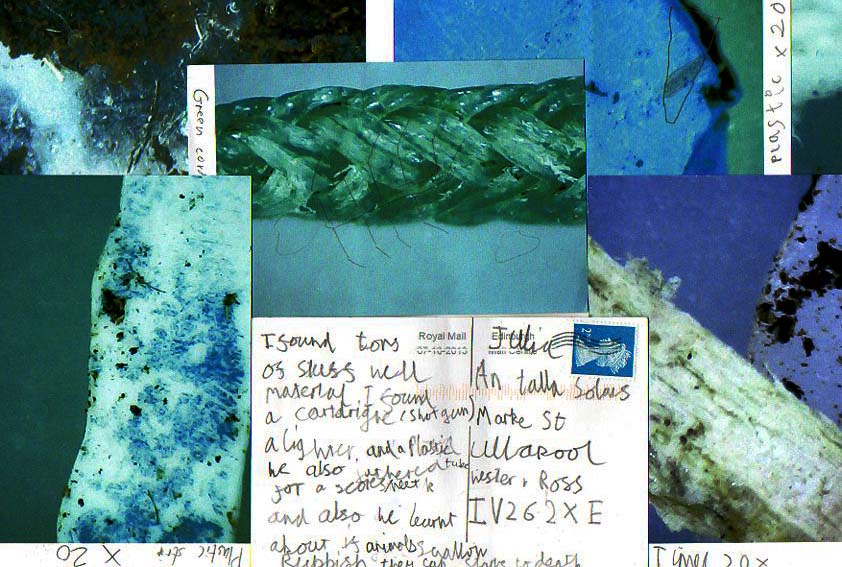
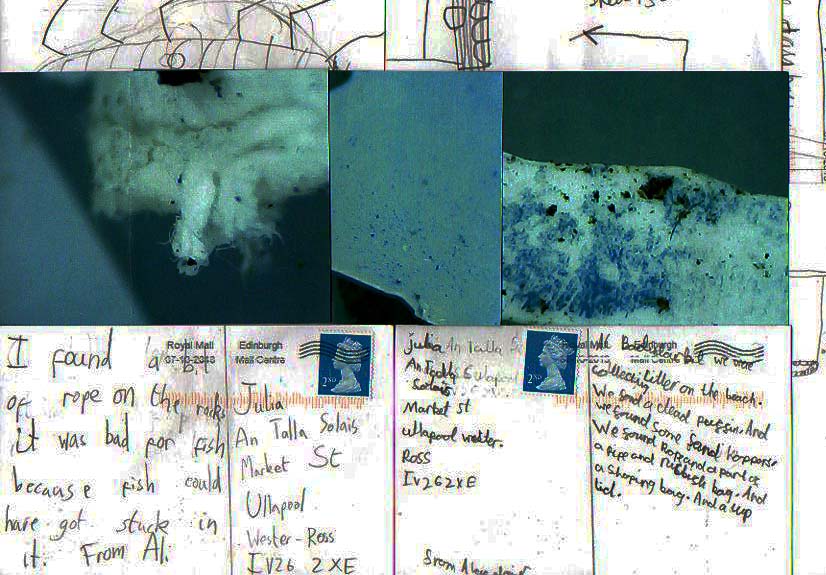
The  captured microscope images of plastic objects found on the beach at Badentarbet and the children’s words arrived at the studio in An Talla Solais today, in the form of 14 postcards, to the interest of  everyone who called in at the studio. Their observations and thoughts being read carefully to see what they had gleaned from our morning in the littoral zone.

Achiltibuie postcards 2

Follow up reports

Over the lunchtime breaks at the High School interested pupils from years 1 &  2  have been joining me to catalogue the evidence that the year 3 pupils collected with me on the beaches around Ullapool. The survey information has been summarised on the evidence sheets for each 10m section along the 100m Morefield Beach survey transect and samples  have been photographed.

checking the bags    cigarette lighter  crime scene board  6 morefield   making notes on the crime scene board  quadrat evidence  IMG_0502

More detailed quadrat information collected along the West Shore beach provides a very different picture as to what has been found and who might be responsible.

Passersby to the Incident board in the foyer of the school are now offering up suggestions as to the origins of the litter.

‘That stuff never vanishes’

On Thursday  I caught up with Dougie MacCrimmond the official beach cleaner in Ullapool, who has been cleaning the beaches for the last six years, we walked and talked while  picking up pieces of  litter  along the western stretch of the beach.

 Dougie 1 Dougie 2 Dougie3

Dougie is employed by the Harbour Trust like his predecessor before him. As we walked I made my usual list of  litter objects  found each day while walking approximately 100m of the strand line along the beaches in and around Ullapool. I hope this catalogue of lists will  help me map the distribution of different  types of litter and its sources, some being more obvious than others .

As Dougie cleans the beach between three and four times a week.  This  explains why  the amount of litter seen on the beaches is relatively low compared to other coast towns and you only see the odd bottle, can or lump of polystyrene. He  tells me how the amount of rubbish depends on the wind & tides and when there has been a big storm he will come and do an extra days cleaning.  I must ask him next week whether the amount he collects is also influenced by the number of tourists in the town.

We discussed how  the smaller particles get caught and lodged between the rocks.  We talk about how overwhelming the amount of plastic on the beaches has become in the last 20 years and Dougie  adds ‘That Stuff never vanishes’.

Dougie portrait Dougie 4 litter in bag

We mused on the how to counter responses from people when we approach them about leaving litter.  Responses we have heard include’ The most usual response being ‘I am keeping you in a job’ or ‘I’m  keeping the council workers in a job !  Neither of us could come up with what words could persuade them to take their rubbish away and put it in a bin.  Any  ideas?

As we walked off the beach talking about  the issue of the day following a very wet and wild week  i.e the outlook for the afternoon  Dougie  told me ‘We say sometimes the  rain never forgets to go here’ ,  but as  I walked away the rain did stop but unfortunately  I could see another piece of plastic I had missed. By the end of our short walk he reckoned he had collected about 56lbs of rubbish in his bag , several hundred pieces of rubbish.

Collecting evidence

Yesterday September 18th,  I spent the day with 14  year 3 pupils from Ullapool High School who are studying art, biology and environmental sciences.  A perfect group for a  truly cross curricular project as littoral .  After a brief introduction to the project  we spent the morning reflecting on how clean they  considered the beaches near to where they live are and what they commonly find washed up on.  We went on to share thoughts about what the dangers and consequences  are  for wildlife and ourselves and the economy.  A huge amount to grapple with in a short time.

Having a brief overview we headed out to  examine three  beaches around Ullapool .  Morefield beach just below the golf course west of the Ullapool River , the harbour beach west of the pier and West Shore beach near to the sailing club.

MOREFIELD BEACH - Copy

I selected to use the MCS ‘s beach watch survey methods on Morefield,  this involves dividing 100m of beach into 10m sections to be surveyed in detail cataloging all the man-made materials you find walking from the high tide line to the strand line. This was no easy feat as the weather suddenly changed from bright and blustery to gale force driving rain not easy to stand up in or to hold clip boards and take details down. A challenge for everyone!  I am now in the process of deciphering what we noted down .  What is  easy to say is that there was plenty of litter to fill our sample bags several times over.

Thankfully  the task  became  much easier when we got into the protection of the harbour, the shelter of the pier  reducing the wind chill factor markedly. So we were able to focus the scale of our survey  down using  quadrats approximately 50cm square, the observations revealed litter levels were still high though with an increase in the amount food of  packaging .

HARBUR BEACH SURVEY - Copy         harbur beach QUADRAT - Copy         SAMPLE BAG - Copy

While looking more closely we had the opportunity to discuss the dangers  that each type of object presents.  I intend to find ways of sharing looking even more closely into the issue with the pupils over the next few weeks at the high School and at the primary schools.