‘That stuff never vanishes’

On Thursday  I caught up with Dougie MacCrimmond the official beach cleaner in Ullapool, who has been cleaning the beaches for the last six years, we walked and talked while  picking up pieces of  litter  along the western stretch of the beach.

 Dougie 1 Dougie 2 Dougie3

Dougie is employed by the Harbour Trust like his predecessor before him. As we walked I made my usual list of  litter objects  found each day while walking approximately 100m of the strand line along the beaches in and around Ullapool. I hope this catalogue of lists will  help me map the distribution of different  types of litter and its sources, some being more obvious than others .

As Dougie cleans the beach between three and four times a week.  This  explains why  the amount of litter seen on the beaches is relatively low compared to other coast towns and you only see the odd bottle, can or lump of polystyrene. He  tells me how the amount of rubbish depends on the wind & tides and when there has been a big storm he will come and do an extra days cleaning.  I must ask him next week whether the amount he collects is also influenced by the number of tourists in the town.

We discussed how  the smaller particles get caught and lodged between the rocks.  We talk about how overwhelming the amount of plastic on the beaches has become in the last 20 years and Dougie  adds ‘That Stuff never vanishes’.

Dougie portrait Dougie 4 litter in bag

We mused on the how to counter responses from people when we approach them about leaving litter.  Responses we have heard include’ The most usual response being ‘I am keeping you in a job’ or ‘I’m  keeping the council workers in a job !  Neither of us could come up with what words could persuade them to take their rubbish away and put it in a bin.  Any  ideas?

As we walked off the beach talking about  the issue of the day following a very wet and wild week  i.e the outlook for the afternoon  Dougie  told me ‘We say sometimes the  rain never forgets to go here’ ,  but as  I walked away the rain did stop but unfortunately  I could see another piece of plastic I had missed. By the end of our short walk he reckoned he had collected about 56lbs of rubbish in his bag , several hundred pieces of rubbish.
littoral: tutorial

Arriving on the Isle of Cumbrae  early on Thursday morning at low tide I was able to watch the terns and oyster catchers rigorously working the tide lines for food. A perfect start to my day  dedicated to  focusing  on techniques to help me get to know what’s happening in the littoral zone around our coast.

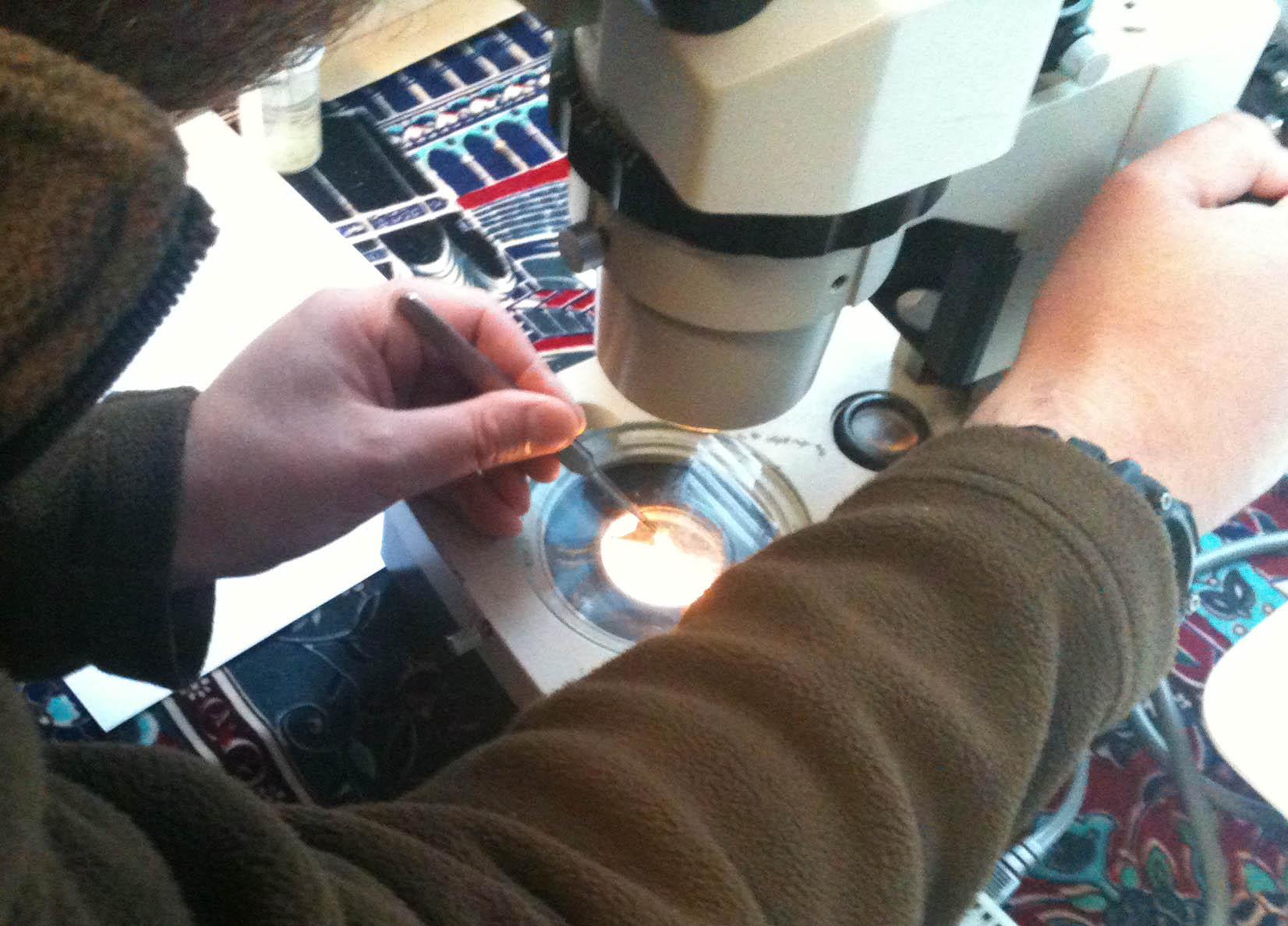
My   eagerly awaited tutorial with marine Biologist Dr Phillip Cowie at  UMBSM ( the University Marine Biology Station on the Isle of Cumbrae  Millport) covered top tips on simple best practice microscopy, advantages of certain microscopes, effects of different light sources and ways of taking photographs through the microscope using a digital camera

  microscope techniques

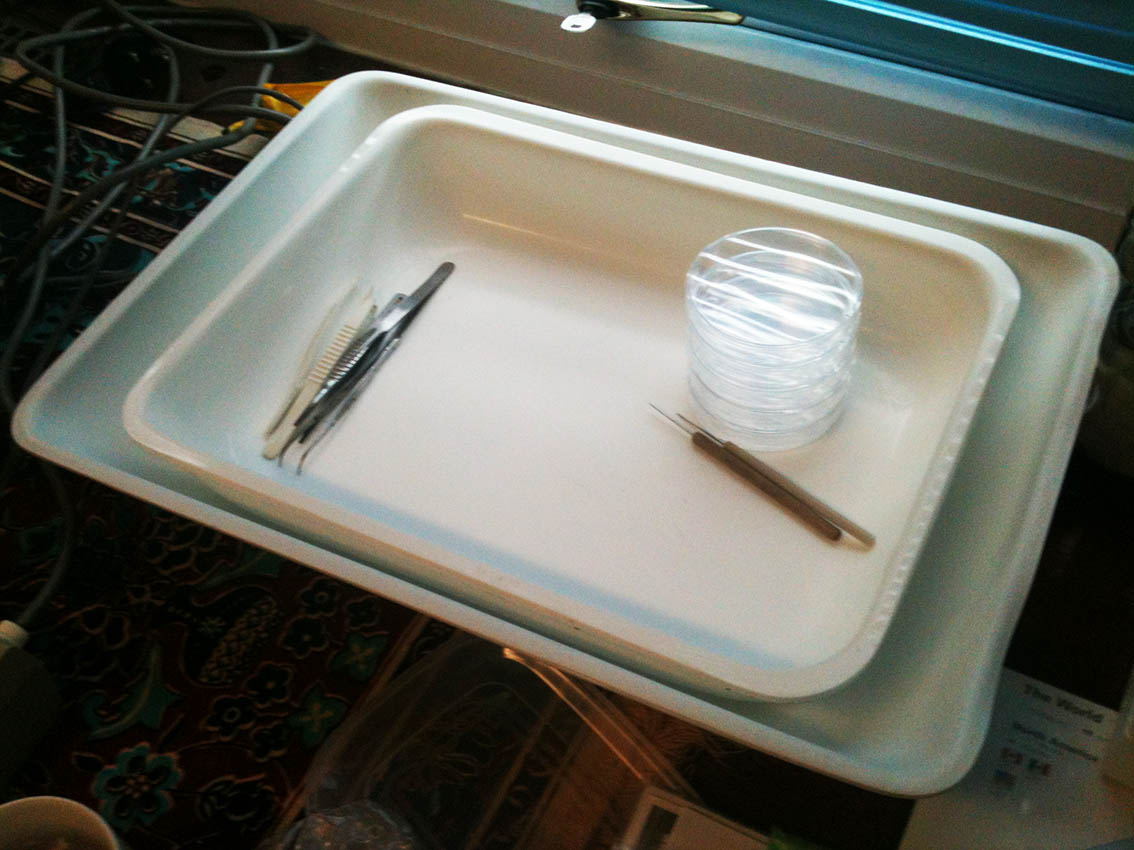
Equipment and methods required for separating out different man-made particulates collected. As most low to medium density plastics float separation is easy and effective through immersing in trays of water and picking them out with tweezers to examine. Butchers dishes , tweezers……

 basic equipment needed

The range of plastics in one small sample from the strand line near the station at the mouth of the Clyde is huge  the cheaper end of the market using Polyethelene  eg household string, plastic bags (right hand rope).

material difference between ropes

Stronger products such as load baring ropes and clothes are made from Polypropalene this form of plastic being manufactured from individual fibres (left hand rope), the strands of which are at the centre of the stations research, filaments are now being recorded in a host of marine organisms including fish, crustaceans such as the Nephrops (pictured here) and most disturbingly in organisms as small as sand-hoppers.

Nephrop

 As sand-hoppers are food for so many birds feeding on our beaches I hope in someway to highlight this fact in my work . We then discussed the ways of capturing and keeping sand-hoppers alive in tanks for a display illuminating the issue of ingestion of fibres and the existence of plastic in the food chain. Dr Cowie pointed out that it’s difficult to be able to extrapolate and project the significance of their findings without continued and wider research into feeding habits of fish and other marine organisms.

Unfortunately this though will not now be continuing on at the station.

P.S By the end of the day I had been able to work on microscope techniques, build up my knowledge regards  identification of different types of plastics and the possible sources/origins of them. I was able to discuss the implications of the different            materials to marine organisms and  broaden my understanding of the proposedresponses to managing beach litter.The Station was an appropriate place for me to build  my marine education essential  for my littoral project as it was founded in 1885 on the ‘Ark’ a boat fitted out as a laboratory and  run by the islands naturalist Dr D Robertson and was visited by distinguished scientists  and inspired hundreds of amateur naturalists like myself.

I would like to thank Dr Cowie for his enthusiastic support for my project, wish him and the research team luck and success in carrying their research on in the future and to encourage  anyone who has the opportunity to visit the station.